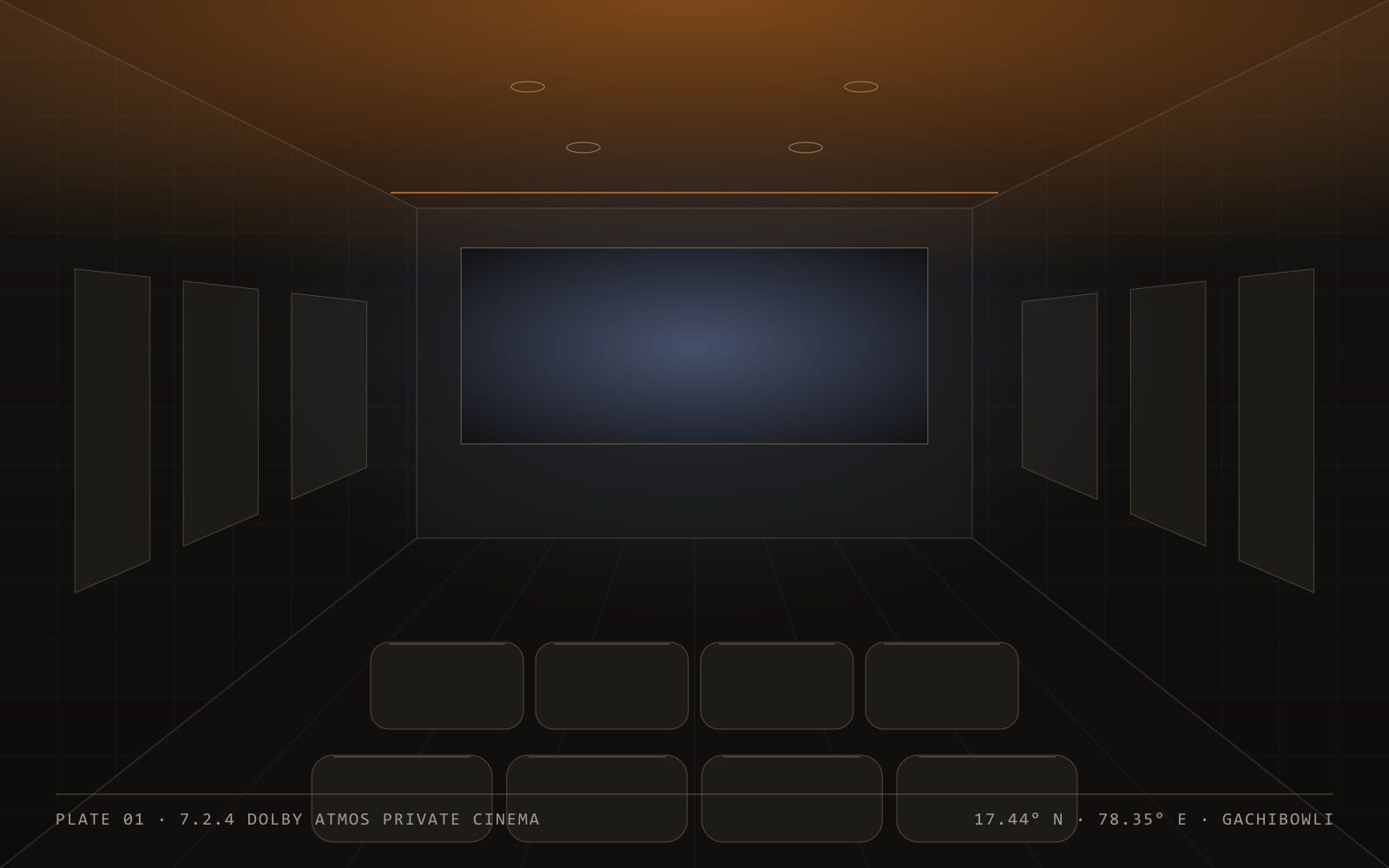
01 / Acoustics · RT60: 0.32s · 7.2.4 Dolby Atmos

Custom Dolby Atmos home theaters in Hyderabad, calibrated to every seat.

From a concealed 5.1.2 living room in Gachibowli to a 9.2.6 reference screening room in Jubilee Hills, AV Box designs the room, the acoustics and the electronics as one instrument — then measures it with a microphone until it performs.
Dedicated 7.2.4 Dolby Atmos private cinema in a Hyderabad villa with fabric acoustic panels and motorized recliners
EDC · Elevated Digital Cinema XperienceAV Box
Formats
5.1.2 → 9.2.6
Target RT60
0.25–0.4 s
Screens
100–150"+
Indicative
₹2.2 L → ₹30 L+

01 EDC · Elevated Digital Cinema Xperience

The equipment is the easy part. The room decides how it sounds.

Most disappointing home theaters in Hyderabad have good equipment in an untreated room. Vitrified tile, Italian marble, glass and RCC walls reflect sound almost perfectly, so dialogue smears, bass booms at one seat and vanishes at the next, and overhead effects lose their position.

EDC is our design method for fixing that at the source. We start with the room's dimensions and construction stage, choose a speaker layout that fits it, plan acoustic treatment around your interior design, and finish with measured calibration. The result is a cinema that sounds the same at the back row as at the director's chair.

Every project is drawn first: speaker angles to Dolby's placement guidelines, seating distance for your screen size, riser height for clear sightlines, and conduit routes your builder can follow before plastering.

02 Room topology matrix

Pick a room. See the speaker map.

Three formats cover almost every Hyderabad home. Each layout below is a real planning starting point, with indicative turnkey budgets.

Select a room format
Top-down Dolby Atmos 5.1.2 · 12×15 FT speaker layoutAcoustically transparent screenMLP5.1.2 · 12×15 FT

12×15 ft · 5.1.2 · Indicative ₹2.2 – 4.5 Lakhs

Media room or open living space

Ideal for apartments in Gachibowli, Kondapur and the Financial District where the living room doubles as the cinema. Speakers go in-wall or in-ceiling so the room still looks like a living room.

Room volume≈ 1,800 cu ft at a 10 ft slab
SpeakersLCR + 2 surrounds + 2 in-ceiling Atmos + 1 subwoofer
Processing7-channel Dolby Atmos AV receiver (Denon / Marantz)
Display75–85" 4K TV or 100" ALR screen with laser UST projector
SeatingSingle row, 3–4 seats; sofa can stay
AcousticsRug, curtains and 4–6 absorptive panels at first reflections
Top-down Dolby Atmos 7.2.4 · 15×20 FT speaker layoutAcoustically transparent screenMLP7.2.4 · 15×20 FT

15×20 ft · 7.2.4 · Indicative ₹6.5 – 14 Lakhs

Dedicated private cinema

The most-requested format for villa basements in Kokapet and Tellapur. Two subwoofers smooth bass across both rows, and four overhead channels place rain and flyovers precisely above the seats.

Room volume≈ 3,000 cu ft at a 10 ft slab
SpeakersLCR behind screen + 4 surrounds + 4 Atmos + 2 subwoofers
Processing11-channel processing with room correction
Display120–135" acoustically transparent screen, native 4K projector
SeatingTwo rows of motorized recliners, second row on a 12–18" riser
AcousticsTarget RT60 ≈ 0.3 s, corner bass traps, rear-wall diffusion
Top-down Dolby Atmos 9.2.6 · 18×28 FT speaker layoutAcoustically transparent screenMLP9.2.6 · 18×28 FT

18×28 ft · 9.2.6 · Indicative ₹15 – 30 Lakhs+

Reference screening room

Built for estates in Jubilee Hills and Banjara Hills where the cinema is a destination. Front wides close the gap between screen and surrounds so pans feel continuous for every seat, not just the centre.

Room volume≈ 5,000+ cu ft, often double-height
SpeakersLCR + front wides + 4 surrounds + 6 Atmos + 2 or more subwoofers
ProcessingSeparate processor + multichannel power amplification
Display150"+ scope or 16:9 screen, JVC D-ILA or 4K laser projection
SeatingThree tiers of custom motorized recliners
AcousticsRoom-in-room isolation, acoustic doors, quiet HVAC (NC 25)

03 Theater speakers

Theater speakers matched as a family.

Dialogue lives in the centre channel, so the left, centre and right speakers must be timbre-matched — ideally identical — and placed at ear height or angled toward the seats. In dedicated rooms we mount them behind an acoustically transparent screen so the voice appears to come from the actor's mouth.

Surrounds sit slightly above ear level at roughly 90–110° for 5.1 layouts, with rear surrounds at 135–150° for 7.x systems. Front wides, used in 9.x rooms, bridge the gap between screen and side walls so pans feel seamless.

We specify from Klipsch, Episode and QSC depending on room size, target loudness and whether the speakers should disappear into walls or stand as furniture.

Speaker planning rules we follow

  • LCR timbre-matched; tweeters near ear height or toed-in
  • Surrounds 60–90 cm above seated ear height
  • Two subwoofers for any room with two seating rows
  • Sensitivity and power sized for reference level at the back row
  • In-wall back boxes in drywall to prevent rattles and leakage

04 Acoustics & calibration

Acoustic treatment for marble, glass and RCC rooms.

Treatment is planned with your interior designer so it reads as fabric wall panelling, timber slats or a feature wall — not a recording studio. Below is what goes into a typical AV Box private cinema.

Reference screening room with diffusers on the rear wall and fabric-wrapped absorption panels
Rear-wall diffusion · 9.2.6NC 25 HVAC
A1 Reverberation time (RT60) targets 0.25–0.4 s · 500 Hz–2 kHz

RT60 is how long sound takes to decay by 60 dB. An untreated tiled room in Hyderabad often measures 0.8–1.2 seconds, which blurs dialogue and effects. For a private cinema we usually target about 0.25–0.4 seconds across the midrange, evenly — the goal is a controlled room, not a dead one.

A2 Absorption, bass traps and diffusion Rockwool · fabric frames · corner traps

Fabric-wrapped Rockwool or polyester panels go at first-reflection points on side walls and the ceiling. Thick corner bass traps tame the low-frequency build-up that hard RCC boxes produce. The rear wall gets diffusion so the room keeps a sense of space instead of sounding muffled.

  • Side-wall and ceiling first reflections absorbed
  • Floor-to-ceiling corner traps where room modes peak
  • Rear-wall diffusers or a mix of absorption and diffusion
  • Carpet or a thick rug over marble and tile
A3 Sound isolation for villas and apartments Room-in-room · acoustic doors · quiet AC

Isolation keeps the cinema from waking the house and keeps traffic and generator noise out. Depending on budget we use decoupled stud walls with double drywall and damping compound, isolation hangers for the ceiling, a solid-core acoustic door with seals, and low-velocity AC diffusers so air noise stays below the soundtrack's quietest passages.

A4 Our calibration workflow Microphone measurement · subwoofer integration · picture
  1. Measure every seat with a calibrated microphone before any correction.
  2. Position and phase-align subwoofers to smooth bass across rows.
  3. Set levels, delays and crossovers; run room correction (Audyssey MultEQ XT32 or Dirac Live, depending on the processor).
  4. Verify by measurement and by listening to reference material together with you.
  5. Calibrate the projector or display for brightness, contrast, colour and HDR tone mapping in your room's light.

05 Projectors & screens

4K and laser projection, sized to your seating distance.

Screen size follows seating distance, not wall size. In a dedicated room we aim for an immersive viewing angle of roughly 40–50° from the main seat, which usually means a 120–150 inch screen in a 15–28 ft room. The projector is then chosen for that screen's size, gain and the room's light control.

For dark, dedicated cinemas, native 4K JVC D-ILA projectors deliver deep contrast. For media rooms and living spaces with daylight, 4K laser projectors from BenQ and Optoma pair well with ambient-light-rejecting screens, including ultra-short-throw models that sit just below the screen.

Room typeProjectionScreen
Dedicated, light-controlledNative 4K / laser, long throwAcoustically transparent, gain ≈ 1.0
Media room, some daylight4K laser, high brightnessALR, fixed frame
Living room4K laser UST or large-format TVUST-specific ALR or none

06 Theater seating

Motorized recliners on a riser that respects sightlines.

Seating is where comfort meets acoustics. We plan seat width, recline clearance from the rear wall, aisle widths and riser height together, so the second row sees over the first and every head sits within the speakers' sweet spot. A 12–18 inch riser is typical for a two-row private cinema.

Motorized recliners with adjustable headrests, USB charging and cup holders are standard; tactile transducers can be added for low-frequency effects you feel through the seat. Upholstery options run from performance fabric to leather, chosen to match the room's acoustic panelling.

07 Beyond the cinema room

Music and movies in every other room.

07.1

Living room audio

A 5.1.2 Dolby Atmos system that suits a formal living room: slim front speakers or in-wall LCR beside the TV, a subwoofer tucked into joinery, and Atmos speakers in the false ceiling. Your sofa stays where your interior designer wants it.

5.1.2 · Concealed

07.2

Ceiling speakers

In-ceiling speakers with back cans, mounted in the gypsum false ceiling below the RCC slab. Back cans prevent sound leaking to the floor above and keep bass consistent. Paintable, edge-to-edge grilles disappear into the ceiling.

Back cans · Paintable

07.3

Multi-room audio

Independent music zones for the kitchen, bedrooms, deck and pool, streamed from your phone with HEOS-enabled Denon and Marantz electronics or a centralized amplifier in the rack. Zones can join an automation scene, so "Evening Lounge" starts the music too.

Zones · Streaming · Scenes

08 Walkthroughs

See a 7.2.4 basement cinema in Kokapet.

Acoustic panelling, an acoustically transparent screen, two subwoofers and two rows of motorized recliners in a triplex villa basement.

Read the project notes →
7.2.4 · 15×20 FT · BASEMENT@AVBOXINDIA

09

FAQ · Straight answers

Questions Hyderabad homeowners ask us

01 How much does a Dolby Atmos home theater cost in Hyderabad?

As an indicative turnkey guide: a 5.1 or 5.1.2 living-room system is ₹2.2–4.5 lakhs, a dedicated 7.1.4 or 7.2.4 private cinema with acoustics is ₹6.5–14 lakhs, and a 9.2.6 reference screening room with recliners and isolation starts around ₹15 lakhs and can exceed ₹30 lakhs. The final quote follows a site or blueprint review.

02 What room size do I need for a 7.2.4 Dolby Atmos cinema?

Around 15×20 ft with a clear ceiling height of at least 9.5–10 ft works well for two rows of seating, four overhead speakers and a 120–135 inch screen. Smaller rooms can run 5.1.2 or 7.1.4 very effectively with careful placement.

03 When should I involve AV Box during villa construction?

Ideally before plastering and false-ceiling work. That is when speaker back boxes, conduits, projector power and data, subwoofer locations and acoustic framing can be planned at almost no extra cost. Retrofits are possible, but planning early avoids chiselling finished walls.

04 Do marble floors and RCC walls affect home theater sound?

Yes. Hard, parallel surfaces cause echo, flutter and uneven bass. We measure and treat the room with absorption at first-reflection points, bass traps in corners, diffusion on the rear wall and a rug or carpet, typically targeting a reverberation time (RT60) of around 0.25–0.4 seconds.

05 Can I audition a Dolby Atmos setup before buying?

Yes. Our Experience Center in Vinayak Nagar, Gachibowli has a working Dolby Atmos room. Book a slot on WhatsApp at +91 93557 83557 and bring content you know well.

Concierge · Vinayak Nagar, Gachibowli · +91 93557 83557

Bring a film you know. Hear the difference.

Audition Dolby Atmos, Zigbee lighting scenes and Ajax security in a working room at our Gachibowli Experience Center — then take home a measured, itemised proposal.

Estimate Cost WhatsApp
WhatsApp Concierge · +91 93557 83557